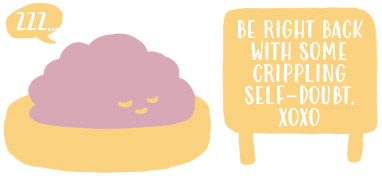


Your brain tells you that new things are dangerous. And it’s right.
If your soul keeps bothering you about that one thing, and you finally decide to pick up that paintbrush, build that business, join that theatre group, you might find yourself overwhelmed or even completely paralysed by the fear of starting something new—a very convincing feeling of dread.
It’s a code red in your brain, telling you that you are stepping into danger. Your soul might ache for a new adventure, but your brain is alerting you to a dire threat.
You might ask: “What? I’m just thinking about getting myself a sketchbook for doodling. That’s not a matter of life and death?”
But you would be wrong. Every time you start something new, an old version of you dies. Every time you venture past the beaten path, you challenge a preconceived notion about yourself. Every time you show yourself in the world, you risk your place in it, your sense of safety, the idea other people have of you.
Let’s call our monsters by their names.
That might sound really dire, but let’s face it: If you clicked on this post, I’m pretty sure this feeling already has a hold on you. So let’s name it for what it is.
There is a part of you that’s stifled by the fear of starting something new because it means letting go of the familiar comfort and predictability of the status quo. And for your fearful brain, that is scary, because the status quo—the routine of your life—must be good, since it has gotten you this far.
That’s why your brain invests all its energy in maintaining the status quo, prioritising perceived safety over your current unhappiness, catching you in a loop of procrastination and frustration.
While your soul might be ready to let go of that limiting, bruising container of your potential, your brain is not. And I think there is great value in acknowledging that. But without shame and guilt, please.
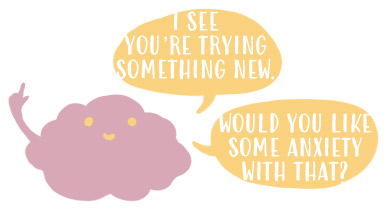
Maybe you can even find it in you to thank that ‘squishy little thinking pudding’ for its diligent, albeit misguided, efforts to keep you alive and safe. No matter how many infuriating mental struggles and dysfunctional habits you might have, say, “Thanks, you little weirdo.”
Can you feel the tension ease a bit?
I feel something in me quieten a little, as I struggle to get the very first blog post of my life out of my system. My brain has been working overtime, questioning every word I write and the entire endeavour of starting a blog in the first place.
“This draft is a mess,” she says. “It’s too personal. Now it’s not personal enough. It’s too weird. It’s too bland. Too short. Too long.”
And I let her vent, nag, and bicker. What else am I supposed to do? If we could just switch off our thoughts, I wouldn’t be writing this post, and you wouldn’t be reading it.
I listen to those fears and concerns—but in the same way I listen to my dog:
- My dog barks, so I check out what’s got her worked up.
- I show her that I either have an eye on what worries her or I consider it unproblematic.
- I name the thing out loud, “It’s the neighbour’s kids. They’re playing.” (She understands the words ‘kids’ and ‘play’.)
- I let her know that I’m grateful for her vigilance, saying, “Thank you for keeping watch.”
- Then I watch those pointy little ears relax, and her little butt settle back on her bed.
Be kind to the little yapper between your ears.
When I ask you to do the same with the little watchdog between your ears, you might object that things aren’t always so simple when it comes to your anxious brain. And I’d answer that my dog isn’t always this easy to handle either.
Sometimes, she’s anxious for reasons I can’t figure out. Or her struggles are too complex to soothe with a single word. And on those days, I can only prescribe rest, extra snuggles, a little treat, or some distraction. Because anxiety isn’t always something to get rid of or knuckle through. Sometimes, it’s a signal that you need comfort and care, to create a safe internal space from which to face challenges.
So, when I manage to be this kind and understanding with my dog, I can extend that gentleness to my brain screaming at me whenever I step outside the bounds of what it deems safe. And I invite you to do the same.
When perfectionism disguises itself as Reason and self-awareness.
Most of the anxious brain’s worries need to be filed away in the ‘aimless spirals’ folder or under the ‘somebody needs a hug’ category. They need to be acknowledged and then gently let go. Some of them might need a deeper exploration into your inner workings with the help of therapy, journaling, or community-based support systems to address their root causes.
But there will be voices inside you that do not cry, yell, or nag like a whiny child in need of a good, long nap. Those voices sound remarkably like reason, common sense, or valid concerns.
The fear of starting something new has many faces.
If you manage to brave the nebulous sea of pessimism, the brackish waters of anxiety, and the sticky tar pit of insecurity, you will face your brain’s last line of defence in its efforts to keep you from venturing into new uncharted territory.
Its objections to your wonderful new plans will sound very reasonable. Your brain will tell you things like:
- “I don’t have enough experience to start a knitting group.”
- “The timing is inconvenient. Let’s start that business next year.”
- “I should get in shape first before starting this dance class.”
- “My family needs me, I’ll start writing my book when things quiet down.”
- “I don’t have money for a proper gym outfit, so I can’t start working out.”
- “I should only start posting on social media if I have something meaningful to say.”
All of these points are merely an expression of your fear of starting something new, the desire for order and safety, also known as perfectionism.
You might think that your brain is simply giving you a list of reasonable concerns to check off before you can start a new adventure, but it’s really just an advanced level of procrastination. For every item you check off, it’ll invent two more to keep you from starting.
Perfectionism is the embodiment of fear.
In future blog posts, I will address the challenges of distinguishing perfectionism from aspiration, fears from valid concerns, preparation from procrastination, and anxiety from intuition. But for the sake of not turning this post into a book—as was the fate of the first three drafts—I will share my simple rule of thumb:
The anxious side of your brain is pushy, urgent, and black and white. Your intuitive mind is unhurried, soft, and expansive.
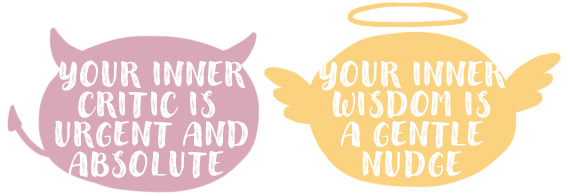
Unlike your inner wisdom, anxiety also makes itself known through physical symptoms. If I sit in front of my computer with my shoulders up to my ears, chewing my fingernails and stressing about writing the perfect blog post, that’s probably a sign to step away for a minute, and not to delete everything I wrote for the third time.
To filter out the anxious noise, learn to quiet your mind by connecting with your body. Stress often festers in my chest and shoulders. For you, it might be different.
Get to know yourself. What are your signs of stress, and what does your intuition sound like? Be curious, be kind to yourself. Over time, distinguishing your inner critic from your inner wisdom will become a lot easier.
And the valid concerns underneath all those scattered, anxious thoughts? You observe and approach them with curiosity, gratitude, and resourcefulness.
The process of starting something new is rarely instagrammable.
Another reason you might procrastinate the start of something new might be a skewed idea of what starting should look and feel like. When you’ve been watching TikToks and Instagram posts about running for the past six months, getting into those shiny new sneakers might not feel as great as it looks online.
On the first day of your new running habit, you got up an hour later than you planned, and your stomach aches. Breakfast isn’t an Instagram-worthy smoothie—it’s yesterday’s half-eaten burrito. Your cat peed on that new pair of running shoes, and if your hair doesn’t already look like a mess, it definitely will once you step outside into that icky, clammy morning mist.
That might feel like a bad omen, so you crawl back into bed. But in reality, this is the smell of starting something new: cat pee and half-eaten burritos.
Your body and your fearful mind are in cahoots.
For people like us, who struggle with anxiety and perfectionism, starting something new will quite possibly never feel great. There is even neuroscience* on our brains trying to steer us away from new things by making us sleepy or hungry.
*[Scientific article from the National Library of Medicine]
Yes, you read that right. It’s not my fault that I just got up from my computer to raid the cookie jar. Writing this blog post is a challenge, and what’s better than challenges? Cookies. Hard to argue with that logic.
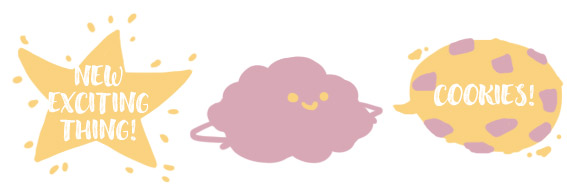
Only one of those things will satisfy me long-term, though—and it’s not the cookies. That’s why I push through procrastination and doubt, or any other obstacle my body and mind set up to keep me from venturing off the beaten path.
I’m used to it. That’s how I built anything meaningful: by pushing against resistance and that nagging sense of wrongness.
Does that sound dreadful? It was rough at first. Now that ache in my stomach signals I’m onto something worth doing.
I no longer wait for experience, confidence, perfection, the stars aligning, or someone’s permission.
Because:
- Experience is gained by making mistakes.
- Confidence comes from experience.
- Perfection is unsustainable—and really, really boring, too.
- The stars will never fully align, and nobody can predict the future.
- And as for waiting for someone’s permission? I don’t know if you noticed, but people are really weird and fickle. We won’t base our life’s decisions on what others deem valid or valuable.
Expand your comfort zone without demolishing it.
Everything I learned about expanding my comfort zone has come through long periods of trial and error. And a lot of self-abuse. I have spent my twenties in a constant cycle of pushing and bending myself out of shape and then collapsing and retreating.
Growing up in a society obsessed with self-optimisation and squeezing people into boxes, I learned to treat my needs and even my abilities as obstacles to bulldoze over. And then I wondered why I felt so broken.
My perfectionism had such a tight grasp on me that I was too paralysed to do anything. My idea of discipline and self-care was so rigid it left no room to live, let alone thrive.
In all your efforts to overcome your fear of starting something new, I don’t want you to become the 20-year-old version of me. Or at least, I hope that you’ll learn from the errors of ruthless self-optimisation a lot quicker than I have.
Is it really the fear of starting? Or do you have a habit of abusing yourself?
Do you really need to wake at six and hit the gym at seven? Do you really have to become a social butterfly? Do you really need a six-figure business to feel valuable? Do you really have to be great at drawing to make it a meaningful pastime?
I thought I did, and when I realised that I couldn’t achieve those goals, I didn’t adjust them to something more reasonable. I froze. If I couldn’t maintain perfection, I wouldn’t do anything.
In hindsight, this feels really silly. But a lot of neurodivergent, highly sensitive people fall into this trap, especially if we lack support systems, education, and a safe environment to explore our capabilities and our limitations.
That’s why I want to invite you to be kind, curious, and realistic about your aspirations. Most of us are so lenient and understanding with our friends and our pets, and so ruthless and mean with ourselves.
Curiosity and kindness as an antidote for fear and perfectionism.
I moved out of the noisy, busy city so my anxious dog could find peace, when in reality I needed the peace and quiet of rural life much more than she did. I needed to let go of this fantastical idea of myself that would thrive in that big-city hustle to uncover the version of myself who finds strength in long forest walks and growing wildflowers in her garden.
The overstimulated version of myself was not capable of handling the ‘dangers’ of starting a blog, all imperfect and insecure. The version of myself who slept til 9 and faced the day with a walk in the sun and a big pot of tea, is excited about starting messy and unprepared. Because that’s where anything meaningful grows.
And I hope you get there, too.